

What Happens to Your Brain While You Sleep?
For a long time, I thought that sleep was just the body’s way of relaxing after a busy day.
If there was work to do, another episode to watch, or a little more time on the phone, sleep was the first thing that would be sacrificed.
I would tell myself, “I’ll sleep later.”
Maybe you’ve done it too.
I didn’t realize that while I was “saving time” by sleeping less, my brain was actually missing out on some of the most important tasks it does every night.
Surprising fact:
When you sleep, your brain doesn’t completely shut down.
In fact, many neuroscientists say it gets very busy behind the scenes.
While you sleep, your brain:
- Organizes memories
- Processes emotions
- Repairs important connections
- Cleans up junk
- Prepares you for the next day
That’s why after a good night’s sleep, you’re able to solve problems more easily, remember things better, and even feel happier.
While poor sleep can lead to forgetfulness, irritability, and mental fatigue.
Experts from institutions like the NIH, Sleep Foundation, and Cleveland Clinic say that good sleep is one of the most important things for mental health.
It’s not just about relieving fatigue — it’s about giving your brain time to do important things that it can’t do while you’re awake.
Understanding this has completely changed the way I think about sleep.
Now I don’t think of sleep as “lost time” but as an investment in my brain.
Let’s take a look at what actually happens inside your brain while you sleep.
Your brain never really sleeps
The biggest myth about sleep is that the brain “shuts down” at night.
This isn’t true.
The body rests, but billions of brain cells keep communicating with each other throughout the night.
Scientists can see this activity by looking at the brain’s electrical waves.
The different stages of sleep have different waves, and each stage has a different function.
These patterns are closely regulated by your body’s 🔗circadian rhythm, an internal clock that tells your brain when it’s time to be awake and when it’s time to sleep.
Sleep occurs in four different stages
Another important thing I learned:
Sleep is not one long, continuous state.
Instead, your brain goes through several different stages each night.
All of these stages together are called a sleep cycle.
A complete cycle lasts about 90 minutes.
Most healthy adults go through 4 to 6 cycles throughout the night.
Each stage has its own purpose.
Stage 1 – Light sleep
This is the transition from wakefulness to sleep.
In this stage:
- The heart rate begins to slow down
- Breathing becomes more relaxed and slower
- Muscles begin to release tension (relax)
Many people experience sudden muscle twitches (twitches) during this stage—this is completely normal.
This stage only lasts a few minutes, but it is the gateway to deep sleep.
Stage 2 – Brain Preparation
In this stage:
The brain becomes less attentive to the outside world (less aware).
Body temperature drops slightly.
Heart rate slows down even more.
The brain begins to process all the information it has gathered throughout the day.
Important:
Adults spend about half of their entire night’s sleep in this stage.
This stage is much more important than most people realize.
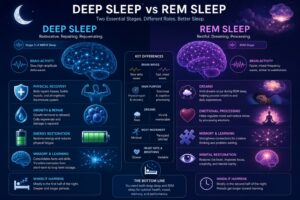
Stage 3 – Deep Sleep
It is also often called slow-wave sleep
This is the stage where the body does most physical repair and the brain does important maintenance.
If someone wakes you up from deep sleep, you will feel confused and groggy, because the brain is still in recovery mode.
In this stage:
- Growth hormone is released
- Body tissues are repaired
- The immune system is strengthened
My personal lesson:
After learning about deep sleep, I figured out why I didn’t feel refreshed even after sleeping 8 hours.
Sometimes the hours would go by, but deep sleep wasn’t enough.
Stage 4 – REM Sleep
The last stage of the sleep cycle is called REM sleep (rapid eye movement).
This is the most exciting part of the night.
In this stage:
The most vivid dreams occur
The body remains completely calm, but the brain becomes very active (almost as active as when awake)
Researchers believe that REM sleep does the following:
- Enhances creative thinking
- Helps with learning
- Processes emotions
- Helps with problem-solving.
Have you ever noticed?
Sometimes a problem seems confusing at night, but when you wake up in the morning, the solution suddenly seems clear.
It’s not magic; your brain has been working on it all night.
If you don’t get enough REM sleep, people feel less creative, more emotional, and less able to concentrate.
That’s why sleep protection is so important, not just for the body but for the mind as well.
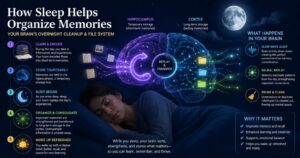
Your brain organizes memories throughout the day
Throughout the day, your brain accumulates a lot of stuff—articles, videos, new information, conversations, tasks, emotions, etc.
The brain can’t keep everything forever.
When you go to sleep, your brain starts sorting through all of this stuff.
It decides which things to remember and which to forget.
Sleep experts call this memory consolidation.
Here’s why:
Students who get a good night’s sleep remember better
Taking a nap after learning a new language, skill, or book can be a huge help
My lesson:
A lot of times I blamed myself for forgetting when the real problem was that I wasn’t giving my brain enough time to process those memories.
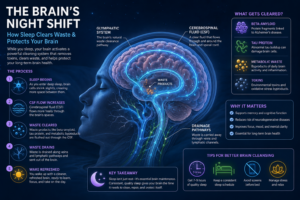
Your brain cleans itself while you sleep
This was the most surprising thing I learned.
The brain naturally produces junk material as it works throughout the day.
During deep sleep, a special brain cleaning system (the glymphatic system) becomes very active.
It washes away and cleans away waste proteins and other toxins.
Because of this cleaning, deep sleep is very important for mental health.
For me:
I used to think that “nothing was happening” while I was sleeping.
Now I know that my brain does maintenance and cleaning work at night that it can’t do during the day.
Sleep regulates emotions
Have you noticed that everything seems more stressful after a bad night’s sleep?
Small problems seem big, small mistakes lead to frustration, and patience quickly wears out.
Reason:
During sleep (especially REM sleep), the brain processes the emotional experiences of the day.
It reduces stress, organizes emotional memories, and prepares for the next day.
When sleep is poor, the emotional part of the brain becomes more sensitive, and the logical thinking part is weakened.
That’s why lack of sleep leads to irritability, anxiety, and feeling overwhelmed.
My experience:
When I had several nights of poor sleep, I would feel exhausted not only physically but also mentally.
If you’d like to understand this connection in more detail, you can also read Why Poor Sleep Is Affecting Your Mental Health (And What Helped Me Fix It).
Your brain repairs important connections
Every day, billions of cells (neurons) in your brain connect to each other through tiny pathways (synapses).
These connections are what allow you to think, learn, remember, and make decisions.
During sleep, the brain strengthens important connections and removes unnecessary ones.
Example:
Think of it like cleaning out a library—useful books are put on shelves, and old, unnecessary books are removed to make room for new information.
This repair helps your brain work more efficiently and quickly the next day.
If you don’t get enough sleep, these connections become weak. That’s why it’s hard to learn new things when you’re sleep-deprived.
What happens if we don’t give our brain enough time?
When I understood what our brain does during sleep, the question immediately arose: What happens if we don’t give it enough time?
The result is
- Difficulty concentrating
- Forgetting small things
- Slow reaction times
- Difficulty making decisions
- Poor mood
- Increased stress
- Reduced work productivity
- Reduced creative thinking
Over time, chronic sleep deprivation has been linked to a number of long-term health problems.
That’s why organizations like the CDC, NIH, and Sleep Foundation repeatedly say to not think of sleep as an “option”—make it a priority.
My biggest lesson:
I stopped thinking of sleep as a “time-waster.”
I now think of it as an investment in my brain—because a good night’s sleep makes me more productive and sharper throughout the day.
What changed for me?
My daily habits completely changed after learning the science of sleep.
I now protect my sleep instead of sacrificing it
I stopped thinking I would “catch up” on the weekend
I became more consistent with my sleep schedule
When I get good sleep, everything else improves:
- Attention is sharper
- Mood is more stable
- Things are easier to remember
Even small tasks seem less stressful
Sleep hasn’t just improved my nights — it’s improved my days too.
If you’re looking for practical ways to improve your sleep, don’t miss my guide How To Improve Sleep Quality Naturally (8 Tips That Actually Worked).
The Bottom Line
If someone had told me years ago that my brain works harder when I’m asleep than when I’m awake, I probably wouldn’t have believed it.
Now I know.
Every night your brain is doing all of these things:
Organizing memories
Processing emotions
Consolidating what you’ve learned
Cleansing your brain
Repairing important connections
Preparing you for the next day
The next time you’re tempted to watch “just one more episode” or scroll through your phone for another hour, remember:
Sleep is not a waste of time.
It’s the best investment you can make in your brain, your mental health, and your future.
Because when your brain sleeps well…
Everything else works better.
A consistent bedtime routine can make a huge difference. You can also read How To Fix Your Sleep Schedule Fast: 9 Simple Steps That Actually Work to reset your body clock naturally.