
The Biggest Sleep Myths Doctors Want You to Stop Believing
“I fall asleep with the TV on every night.”
“I only need five hours of sleep.”
“I’ll catch up on sleep on the weekends.”
You’ve heard it before. You’ve probably said it yourself.
The strange thing about sleep advice is that some popular tips aren’t based on solid science. They’re passed down from person to person, repeated on social media, or someone says, “This works for me.”
Eventually, those opinions start to seem like reality.
The problem is, your body doesn’t care how popular a myth is.
It only responds to biology (the actual workings of the body).
That’s why two people can follow the exact same bedtime routine and wake up feeling completely different in the morning.
Sleep is affected by your:
Brain hormones, age, stress, light exposure, genetics, and dozens of other factors
It’s not a one-size-fits-all rule.
In this article, we’ll separate fact from fiction and explain what sleep experts actually know.
You may find that a belief you’ve trusted for years is quietly working against you.
👉 How To Fix Your Sleep Schedule Fast
Why are sleep myths so hard to bust?
If a health myth has survived for decades, it’s usually because there’s a small grain of truth to it.
For example:
Someone has a glass of wine, falls asleep quickly, and thinks the alcohol improves sleep.
Another person stays up until midnight every weekend and feels fine on Monday, so they think “catching up” on sleep always works.
Our brains naturally rely on personal experience because it’s immediate and memorable.
Science works differently.
The goal isn’t to make sleep more complicated.
The goal is to make the advice more accurate.
Myth #1: Everyone needs 8 hours of sleep
The “8-hour rule” is probably the most repeated sleep advice in the world.
It’s also one of the most misunderstood.
8 hours is a useful average, not a magic number that applies to everyone.
Some healthy adults function best on about 7 hours of good sleep.
Others consistently need closer to 9 hours.
Genetics, age, activity level, and overall health all play a role in how much sleep your body needs.
What does the science actually say?
Sleep experts recommend that most adults aim for 7-9 hours of sleep each night.
But numbers alone don’t tell the whole story.
Imagine two people who both spend 8 hours in bed:
One falls asleep early, stays asleep, and wakes up refreshed.
The other spends an hour trying to fall asleep, wakes up several times during the night, and only gets 6 and a half hours of actual sleep.
Both lay in bed for 8 hours.
Only one got the full benefit.
The quality of sleep is just as important as the quantity of sleep.
What to do instead?
Instead of chasing a perfect number, pay attention to how you feel during the day.
If you’re alert, focused, and rarely need a lot of caffeine, your sleep schedule is already working well for you.
If you’re constantly tired despite spending a lot of time in bed, the problem may be the quality of your sleep—not the clock.
Myth #2: You can catch up on sleep every weekend
“I’ll sleep five hours during the week and make up for it on Saturday.”
If you’ve ever said this, you’re in good company.
Modern life makes it difficult to get enough sleep on weekdays. Work, school, late-night scrolling, and busy schedules often delay bedtime. Many people feel tired by Friday and look forward to sleeping in until noon on the weekend.
It seems like a great solution.
Unfortunately, your body doesn’t see it that way.
What does the science actually say?
Researchers use the term “sleep debt” to describe the difference between the sleep your body needs and the sleep you actually get.
Sleeping in more on the weekends can help reduce some of that debt. It can improve alertness and make you feel more rested.
But it doesn’t fix everything.
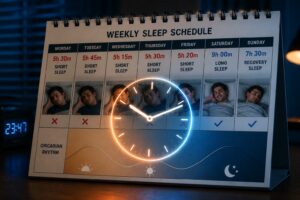
For example, your internal clock (circadian rhythm) likes consistency. If you wake up at 6:30 a.m. on weekdays but sleep until 11 a.m. on weekends, your brain is getting mixed signals.
Some sleep experts call this social jet lag because it can feel like changing time zones every weekend.
Many people don’t get to sleep until Sunday night at their usual bedtime. Then Monday morning comes, and the cycle begins again.
What to do instead?
If you’ve built up a sleep debt, don’t expect one long nap to fix everything.
Instead, add 30-60 extra minutes of sleep over several nights and keep your wake-up time fairly consistent.
Think of it as slowly refilling a depleted battery rather than expecting a quick charge to do everything.
Quick takeaway
Sleeping on the weekend isn’t inherently harmful.
The key to fixing chronic sleep deprivation is to rely on it every week.
Myth #3: Alcohol helps you sleep better
This myth persists because it feels true.
If you drink in the evening, you can fall asleep faster than usual.
Case closed?
Absolutely not.
Going to sleep early doesn’t always mean you’re getting healthy, restorative sleep.
This is where many people get confused.
Why do people believe it?
Alcohol has a sedative effect.
Sedatives can make you feel relaxed and sleepy, so it’s easy to assume that your sleep has improved.
But sedation and natural sleep are not the same thing.
Imagine passing out during a movie.
Technically, your eyes were closed.
That doesn’t mean you saw the movie.
Your brain experiences something similar with alcohol.
It may help you drift off, but it changes what happens for the rest of the night.
What does the science actually say?
As your body breaks down alcohol, your sleep becomes lighter and more fragmented.
Many people wake up more often in the second half of the night without realizing it.
Alcohol can also reduce REM sleep — the stage that is associated with learning, emotional processing, and creativity.
That’s why someone who spends eight hours in bed after drinking alcohol and still wakes up feeling unusually tired.
The problem wasn’t the number of hours.
It was the quality of those hours.
For some people, alcohol can also increase snoring or worsen existing sleep deprivation by relaxing the muscles around the airway.
What to do instead?
If you choose to drink occasionally, try not to make it a part of your bedtime routine.
Giving your body a few hours between drinking and going to bed can help reduce some of the effects of alcohol on sleep quality.
Most importantly: Don’t mistake “falling asleep faster” for “sleeping better.”
Those are two very different things.
Quick Takeaway
Alcohol can help you fall asleep.
It often makes it harder for your brain to get the deep, restorative sleep it actually needs.
Myth #4: Snoring is harmless
Almost everyone knows someone who snores.
Some families even make fun of it.
“It’s just heavy breathing.”
“He snores because he’s tired.”
“It’s normal as you get older.”
Sometimes they’re right.
But not always.
Snoring is a sound that’s made when air struggles to move smoothly through a partially blocked airway.
In many people, it’s harmless.
In others, it can be a warning sign that the brain isn’t getting the steady airflow it needs during sleep.
Why do people believe it?
Because snoring is so common, it is often treated as a personality trait rather than a potential health problem.
If someone snores for years and still goes to work every day, friends and family assume it is nothing to worry about.
But your body can adapt to poor sleep for so long that feeling tired starts to feel “normal.”
What does the science actually say?
Doctors pay attention when snoring is accompanied by symptoms such as the following:
- Gasping or choking during sleep
- Long pauses in breathing
- Waking up with a headache
- Feeling tired despite spending a lot of time in bed
- Fall asleep during the day without any meaning
This obstruction may be a symptom of sleep apnea, a condition in which the airway repeatedly narrows or closes during sleep.
Each pause forces the brain to briefly wake the body up just enough to resume breathing. Most people don’t remember these awakenings, but they disrupt the deep, restorative stages of sleep.
One might think they’ve slept for eight hours.
Their brains have experienced dozens or even hundreds of interruptions.
That’s why untreated sleep deprivation can leave people feeling tired even after staying in bed all night.
What to do instead?
Occasional light snoring isn’t always a cause for alarm.
But if your snoring is loud, frequent, or causes your partner to stop breathing, it’s worth talking to a healthcare professional.
Ignoring the symptoms doesn’t make them any less important.
Quick takeaway
Not every snore is dangerous.
But persistent snoring combined with daytime fatigue should never be dismissed as “old age.”
Myth #5: Your Phone Only Hurts Sleep Because of Blue Light
Ask anyone why phones interfere with sleep and you’ll almost always get the same answer:
“Blue light suppresses melatonin.”
It’s true.
But that’s only part of the story.
If blue light were the whole problem, turning on night mode would solve everything.
Yet many people still struggle to fall asleep using their phones—even with blue light filters enabled.
So what’s really going on?
Why do people believe it?
Blue light has become a buzzword because it’s easy to measure and easy to explain.
As a result, many people assume that once they’ve reduced their blue light exposure, scrolling at bedtime is harmless.
Unfortunately, the brain doesn’t just respond to light.
It also responds to what you’re paying attention to.
That’s why some people put down their phones, turn off the lights… and then spend the next 30 minutes thinking about the video they just watched.
The screen wasn’t the only problem.
What to do instead?
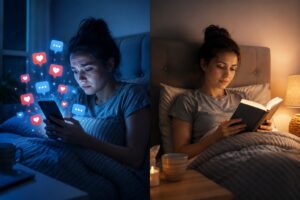
If you must use your phone before bed, try to choose content that allows your brain to slow down rather than speed it up.
Reading a few pages of a book is very different from watching fast-paced videos or responding to stressful messages.
The goal isn’t just to reduce blue light.
It’s to reduce mental stimulation.
Quick takeaway
Your phone affects sleep for more reasons than just its screen.
Sometimes it’s not the light that’s keeping you awake—it’s the content.
👉 How To Improve Sleep Quality Naturally
👉 Phone Before Bed Sleep Quality
Myth #6: If you can’t sleep, stay in bed until you finally fall asleep
This advice seems logical.
If your goal is to sleep, staying in bed will increase your chances, right?
Surprisingly, sleep experts often recommend the opposite.
Why do people believe this?
So when sleep doesn’t come, their answer is to stay there and wait.
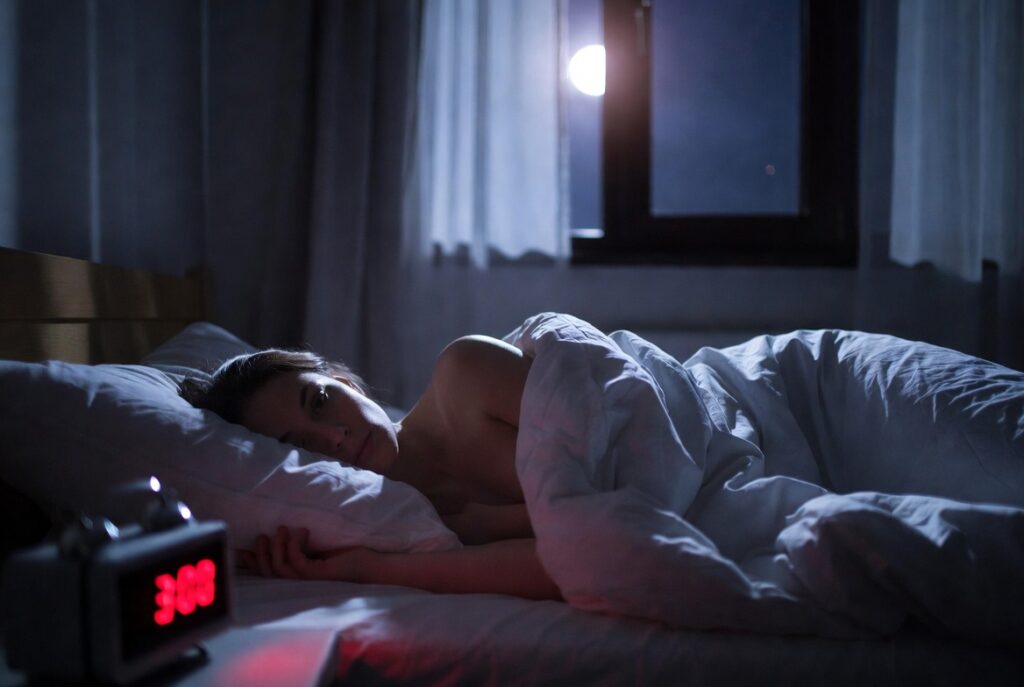
If you spend hours awake in bed worrying, checking the time, or scrolling through your phone, your brain starts to associate bed with wakefulness rather than sleep.
What does the science actually say?
One of the most effective treatments for chronic insomnia is Cognitive Behavioral Therapy for Insomnia (CBT-I).
One principle of CBT-I is called stimulus control.
The idea is simple:
Your bed should become a strong mental cue for sleep—not for frustration.
If you’ve been awake for about 20 to 30 minutes and can’t fall asleep, many sleep experts recommend getting out of bed and doing something calming in dim light.
Read a few pages of a book.
Listen to quiet music.
Practice slow breathing.
Then go back to bed when you feel genuinely sleepy again.
Over time, this helps you re-establish the association between your bed and sleep.
What to do instead?
Don’t look at the clock every few minutes.
Clock watching increases anxiety, and anxiety makes sleep more difficult.
Instead, focus on creating the conditions for sleep rather than trying to force it.
Sleep is something your brain allows.
It’s rarely something you can successfully chase.
Quick takeaway
Don’t teach your brain that the bed is a place to worry.
Teach it that the bed is where sleep begins.
Myth #8: Melatonin is a sleeping pill
People think melatonin works like a sleeping pill.
It doesn’t.
Melatonin simply tells the body that “night has come.” It doesn’t force sleep.
It can help with some conditions (jet lag, etc.), but taking it every night won’t automatically improve sleep.
What to do?
Before supplementing, look at what’s keeping you awake (stress, coffee, phone). It’s more beneficial to fix the cause.
Summary:
Melatonin tells the time; it doesn’t make you sleepy.

Final Thoughts
Sleep myths persist because they have a grain of truth to them.
But even half-truths can be misleading.
What works for someone else may not work for your body.
The best sleep advice is based on research, not personal opinion.
The next time someone says, “Everyone needs 8 hours” or “I’ll catch up on sleep on the weekends,” remember that the story is deeper than that.
Better sleep doesn’t start with believing every tip but with understanding your body.