
Introduction
You’ve studied for hours. You’ve highlighted the important points. You’ve sacrificed sleep to finish one more chapter. And yet, when you wake up in the morning, your mind feels completely blank.
If this sounds familiar, you’re not alone.
Most people think that learning only happens when they’re reading a book, listening to a lecture, or practicing a new skill. These moments are certainly important—but that’s only half the story.
The other half begins when you fall asleep.
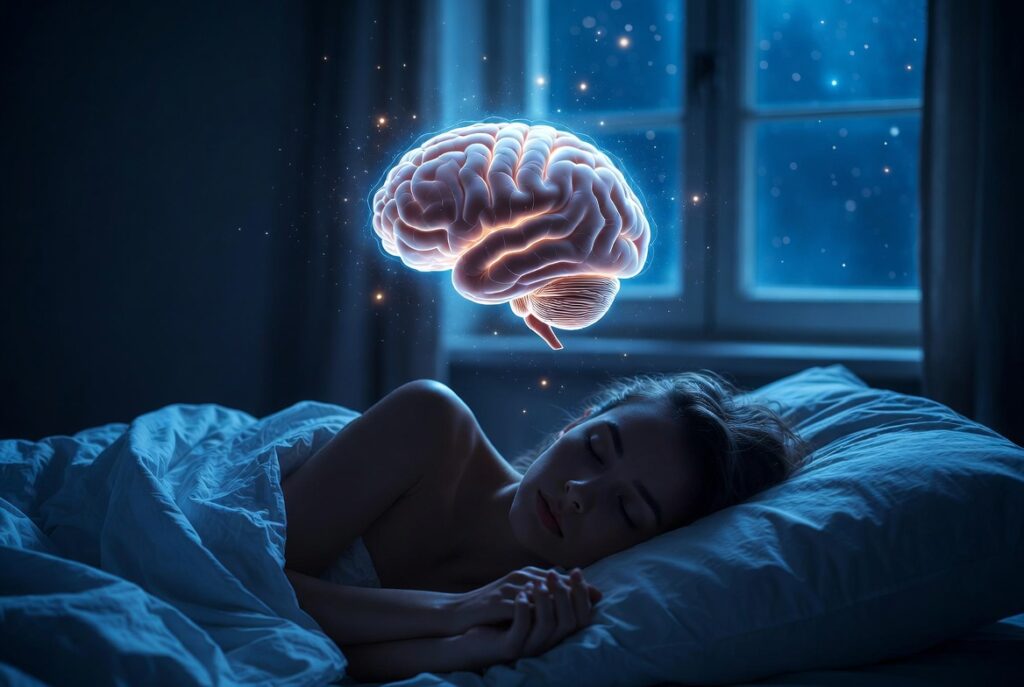
Every night, when the room is quiet and your body is resting, your brain begins a huge task. It organizes the thousands of memories from the day, decides what to keep and what to forget, makes strong connections between important things, and clears out the unnecessary.
In other words, your brain works the night shift.
That’s why a person who studies for just two hours and gets a good night’s sleep often remembers more than someone who studies for five hours and gets only four.
The difference isn’t in intelligence, but in the quality of their sleep.
Let’s take a look at what neuroscientists have discovered about sleep and the brain—and why sleep may be your most powerful learning tool.
How To Fix Your Sleep Schedule Fast: 9 Simple Steps That Actually Work
Your brain has two memory systems—sleep connects them
Think of your brain as a busy office.
Near the entrance is a small but hard-working part called the hippocampus. It’s constantly accumulating new information throughout the day — a friend’s new number, a work presentation, new vocabulary words, or directions to a new place.
But here’s something few people know: The hippocampus isn’t designed to store memories forever. It’s like a temporary folder on your phone. If it all stays there, it’ll fill up quickly, and it’ll be hard to learn anything new the next day.
This is where sleep works wonders.
During deep sleep, your brain moves important memories from the hippocampus to the cortex — your long-term storage room.
Scientists call this memory consolidation.
Just like you move important files to the right folders before you turn off your computer at night.
If this transfer doesn’t happen overnight, yesterday’s information can become a barrier to new learning today.
That’s why not only does poor sleep make it harder to forget old things, it also makes it harder to learn new things.

Why does your brain replay the day when you sleep?
This has even puzzled researchers.
When you sleep, your brain doesn’t just file away memories; it replays them.
Brain-recording studies have shown that the same patterns of activity you engage in during the day resurface during deep sleep.
Imagine practicing a piano piece in the afternoon. At night, while you’re asleep, your fingers aren’t moving at all, but your brain is silently replaying parts of that same piece.
It’s as if your brain is pressing the “replay” button.
Why does it do this?
Because each replay strengthens the connections between brain cells. The stronger these connections are, the easier it will be to remember it later.
That’s why athletes perform better after a good night’s sleep.
Musicians find it easier to play a difficult piece early the next morning.
And students remember lessons more clearly the next day after a good night’s sleep.
Learning doesn’t stop after practice.
Your brain keeps practicing even without you.
CDC Sleep Guidelines
National Institute of Neurological Disorders and Stroke
Why staying up late doesn’t mean learning more
Millions of students and professionals make a big mistake every year.
They think that the more time they spend studying, the better their results will be. At first glance, this seems logical — if two hours is beneficial, then four hours should be even better.
But neuroscience tells a completely different story.
Imagine your glass is already full of water. Now try adding more water to it—eventually it will overflow.
The hippocampus works in much the same way.
After a long day of studying, it becomes less efficient at absorbing new information.
Sleep acts like a reset button.
Without this reset, your brain keeps trying to put new things in a space that’s already almost full. That’s why three extra hours of studying late at night often yields far fewer than expected results.
Your brain isn’t refusing to learn — it’s just asking for some cleaning and maintenance time first.
Why Am I Still Tired After 8 Hours of Sleep?
Your brain’s cleaning crew only works when you sleep
Imagine never taking out the trash.
At first, it may not seem like much of a difference, but after a few days, your home becomes cluttered, smelly, and cramped. It becomes difficult to live comfortably.
Your brain faces a similar challenge every day.
As billions of brain cells communicate with each other, they naturally produce some waste. If this waste is not removed, it slowly starts to hinder brain performance.
Interestingly, scientists have discovered a special cleaning system in the brain called the glymphatic system.
This system is not active all the time, like your heart or lungs. It is especially active during deep sleep.
As you fall into a state of rest, cerebrospinal fluid starts flowing and washes away the day’s waste.
Think of it as a night cleaning crew that comes to work after the office vacates.
One bad night of sleep doesn’t make your brain “dirty,” but consistently poor sleep reduces this important cleaning process.
That’s why good sleep is so important, not just for memory, but for long-term mental health as well.
National Sleep Foundation

Why dreams are more useful than you think
Many people think that dreams are meaningless and random stories.
Some are, but scientists believe that dreams give your brain a chance to connect thoughts, emotions, and memories in new ways — things that aren’t possible while you’re awake.
The brain becomes very active during REM sleep. The parts of your brain that deal with emotions, memory, and imagination connect in special ways. This allows your brain to connect things that would normally seem separate.
It’s like putting together a jigsaw puzzle. During the day, you put the pieces together, and at night, your brain silently tries to put them together in different ways.
That’s why sometimes you wake up with a completely fresh idea, with a solution to an old problem.
It’s not magic — it’s the result of your brain having uninterrupted time to make new connections.
That’s why many writers, engineers, musicians, and scientists say that some of their best ideas come after a good night’s sleep.
Your creativity doesn’t shut down when you sleep — in fact, in many ways, it becomes even more active.
Sleep doesn’t just preserve memories—it also decides what’s important
Many people don’t realize this.
Your brain isn’t trying to remember everything. If it did, it would be hard to find the important things.
Instead, sleep acts like a smart editor.
Imagine taking hundreds of photos on vacation. You won’t keep every blurry or useless photo. You’ll delete duplicates, clean up mistakes, and save only the best ones.
Your brain does exactly that every night.
Experiences that are emotionally strong, are repeated over and over again, or will be important in the future are more likely to be remembered. Unimportant and trivial things gradually fade away.
This selective process protects the brain from unnecessary clutter and keeps it sharp and efficient.
That’s why you can clearly remember important conversations from years ago, but not what you had for lunch on Tuesday three weeks ago.
Your brain is constantly deciding what to keep and what to let go. Sleep is when these big decisions are made.
How To Improve Sleep Quality Naturally
How bad sleep can ruin your learning the next day
You’ve probably noticed it yourself—everything seems harder when you’re sleep deprived.
You have to read the same paragraph twice; even simple tasks take longer, you can’t remember names, and you get lost in the middle of a conversation.
It’s not just because you’re tired.
With insufficient sleep, the hippocampus becomes less able to form new memories.
Simply put, your brain struggles to “store” new information properly.
It’s like trying to download new files to a nearly full phone — some files don’t load properly, some get corrupted.
This is why staying up all night studying before a test often backfires. You’ve not only lost sleep, but you’ve also reduced your brain’s ability to convert new information into lasting knowledge.
Sleep spindles: The tiny brain waves that speed up learning
If scientists were to mention one of the brain’s most interesting learning tools, it would be something most people have never heard of.
They’re called sleep spindles.
These are tiny bursts of brain activity that occur specifically during stage 2 sleep. You don’t notice them, but researchers believe they play a crucial role in consolidating new memories.
Think of them as little messengers carrying information between different parts of the brain.
Throughout the day, the hippocampus accumulates new information. During sleep, sleep spindles help move that information to parts of the brain where it can be stored for long periods of time.
It’s like moving important files from temporary storage to permanent folders.
The faster and better this transfer occurs, the easier it will be to remember that information later.
Interestingly, people who naturally experience more sleep spindles perform better on learning and memory tasks.
Why REM sleep helps you remember feelings (not just facts)
Think about two types of memories.
One: What is the capital of France?
Another: How did you feel on your wedding day or during an important interview?
No two memories are stored in the same way.
Deep sleep is especially important for consolidating factual information, while REM sleep helps you process emotional experiences.
Emotions have a big impact on memory.
Childhood memories—you may not remember every ordinary Tuesday, but you clearly remember the first day of school, a family vacation, or a special birthday. That’s because emotions tell the brain, “This is important; keep it.”
During REM sleep, the brain organizes these emotional experiences, reducing their intensity but preserving the lesson.
That’s why psychologists say that good REM sleep is essential for emotional health as well as learning.
Your brain isn’t just asking “What happened today?”
It’s also asking, “What should I learn from this?”
Can you really learn while you sleep?
You’ve probably seen those ads that claim that you can learn a new language by simply listening to audio while you sleep.
Unfortunately, science doesn’t support this.
Your brain can’t learn new information the same way it can when you’re awake.
But here’s where it gets interesting.
While you can’t learn new things in your sleep, your brain is very good at consolidating what you learned before you went to bed.
In other words, sleep doesn’t replace studying—it complements it.
If you practice your guitar in the evening, review notes, or learn a new skill, your brain is strengthening those neural pathways throughout the night.
That’s why sleep is called the second half of the learning process.
The lesson begins while you’re awake.
Improvement continues during sleep.
How to Make Sleep a Powerful Learning Tool
A simple and effective routine might be:
- Learn new material in the afternoon or evening
- Review key points briefly before bed
- Get 7 to 9 hours of good sleep
- Wake up the next morning and take a few minutes to recall what you learned
This method works with your brain’s natural processes, not against them.
The result? Learning becomes easier and more effective — not because you’re working harder, but because you’re working with your brain.

The Bottom line
Sleep is not a waste of time.
It’s your greatest investment of time.
Every night, your brain quietly organizes memories, consolidates important skills, clears out unnecessary clutter, and prepares itself for new learning the next day.
Even the smartest brains can’t perform at their best with little sleep.
While consistent good sleep makes learning easier, increases focus, boosts creativity, and preserves memories for longer.
So the next time you’re tempted to stay up late to read “just one more chapter,” remember this:
The most important part of learning often begins after you turn off the lights.